Showing posts with label Young Adult. Show all posts

Thursday, May 14, 2015

The Strange and Beautiful Sorrows of Ava Lavender - Leslye Walton


In preparing to write my reaction to this novel, I did a bit of research on the literary technique of using mystical realism in one's plot development. My only experience of the sub-genre (?) is with certain Latin American authors whose stories were so mystic that they were far over my head. I left this type of novel alone for years until I read Like Water For Chocolate, at which point, I thought that I'd fallen back into the mystic just enough.

The point is that this type of writing is not for everyone. You have to let go just a bit of what you consider real and true, latch onto the images and experiences of the characters and accept that what they experience is based in reality - their reality - a reality that serves to say something about life, higher ideals, et cetera. That being said, I found Leslye Walton's debut novel a winner. It's already being short-listed for awards across America as one of the best new young adult reads. I'm not so sure that it is strictly for young adults, but I often think that much of what is written for young adults is really 'cross-over' stuff. That's another rant post, though. Suffice it to say, this story addresses a bunch of issues like opening one's self to love and its messy possibilities, loving enough to allow one's children to become their own distinct personalities, fulfilling one's dreams and not being afraid to fail in the attempt, finding one's self in the midst of one's strong family influence and history, and overcoming society's sometimes harsh assumptions about one's self. Among a bazillion other things ...

Ava Lavender looks back on her life and her family history to tell a tale that will make you feel like you've entered a fairy tale. This is a love story, but it's not about the heart thumping happy ending of romantic love fulfilled. It's about the messiness of love, the development of love over time, the way love is nurtured by some and destroyed by others, the way one comes to love oneself enough to survive sorrows. The members of Ava's family experience love's foibles in vastly different ways and Ava reflects on these joys and sorrows, as her own life moves toward a strange climax.

I loved this book, but I'll warn you. It's not for everyone.


Monday, May 11, 2015

The Truth About Alice - Jennifer Mathieu


Jennifer Mathieu is relatively new to the young adult publishing world and in her first novel, she has hit the ball out of the park, as far as I'm concerned. Don't get me wrong. This is a difficult book to read, especially as a mature woman. It's graphic in its portrayal of young people and the culture of high schoolers and their world. I struggle with the level of sexuality, drugs and alcohol use that young people are exposed to, so reading a book as hard-hitting as this is difficult. That being said, it also flew by for me. it's not a long book. Alice's story unfolds fast and furious.

Monday, January 12, 2015

Eleanor & Park - Rainbow Rowell


Consider me having joined the legions of fans that have read this book and fallen hard for the two characters that collide in the tumultuous chaos of the school bus and are brought together by the creed that one is a 'bully, a lackey, or one of the nameless rabble'. Band together for survival!

Eleanor is new to the neighborhood. She's just been allowed to return to her family , after being kicked out by her stepfather. Her mother and brothers and sister are cowed by the verbal and physical abuse that her step father metes out. Her family is in crisis and they don't even seem able to help themselves. Eleanor's walking on eggs. To boot, she's the red-headed carrot top with more pounds on her than is stylish for the high school mean girl set. Her wild sense of style comes from a combination of defense mechanism thinking, thrift store chic, and teenage rebellion. She's a great target for all the crap that bullies can hand out.

Park is a 'put your head down and survive' kinda guy. He's the one Korean kid in a sea of heartland white bread highschoolers. He survives the chaos of high school by choosing a small group of friends, keeping a low profile, submersing himself in the punk and alternative music of the 80's and staying close to home. His home, in a hard scrabble neighborhood outside Omaha, is 'an oasis', as his family is intact and relatively happy. His parents love and respect each other. His grandparents live right next door. The family is involved with each other and watches out for each other. Life's not all roses for Park, though. His relationship with his ex-military man Dad is tough. His Dad's expectations of Park sometimes make him feel inferior and he struggles with his own teenage rebellious feelings when his Dad puts down his music, his sense of style, his sensitivity, and his apparent inability to learn to drive using a stick shift.

School could be a refuge for Eleanor, but when she steps on the school bus on the first day back with her family, she's greeted by a teen clic culture that has the potential to push her over the edge. And it's then, that Park, looking sideways, slides his backpack out of the way and mutters for her to 'just sit down'. From then on, the voyage to and from school becomes the petri dish for a growing relationship that is so endearing and addicting to read ...

Rainbow Rowell write in short bullets that alternate back and forth between Eleanor's and Park's point of view. Their feelings unfold in bits and starts until they finally befriend each other over the comic books and music that Park shares with Eleanor. Opening up to each other, each cautiously peels back the protective layers that have insulated them from the rough world of teenage culture. It's a tale of love, sacrifice, survival, and hope.

Yes, the language is a raunchy at times (like it is in real life, sometimes). Yes, there are tough issues (like there are in life for far too many young people). Yes, sex is a huge part of the undercurrent of the story (like it is in the minds and hearts of 99.9 % of the teenage world). And yes, Rainbow Rowell deals with all these elements of teenage life really well.

It's no wonder to me that this book has garnered its share of awards - the 2013 Boston Globe Horn Book Award, the 2014 Michael L. Printz Honor Award for YA Fiction, as well spots on the lists of best books of 2013 and 2014 that  the NYT, Publisher's Weekly, NPR, and Kirkus Reviews compile.

Whatever she's doing, she's doing it right. The book's movie rights have been purchased and she will be writing the screenplay for the film adaption, plus she's released her newest novel called Landline, plus she's signed on to produce two graphic novels in the next couple years.

Busy lady !!


Monday, December 8, 2014

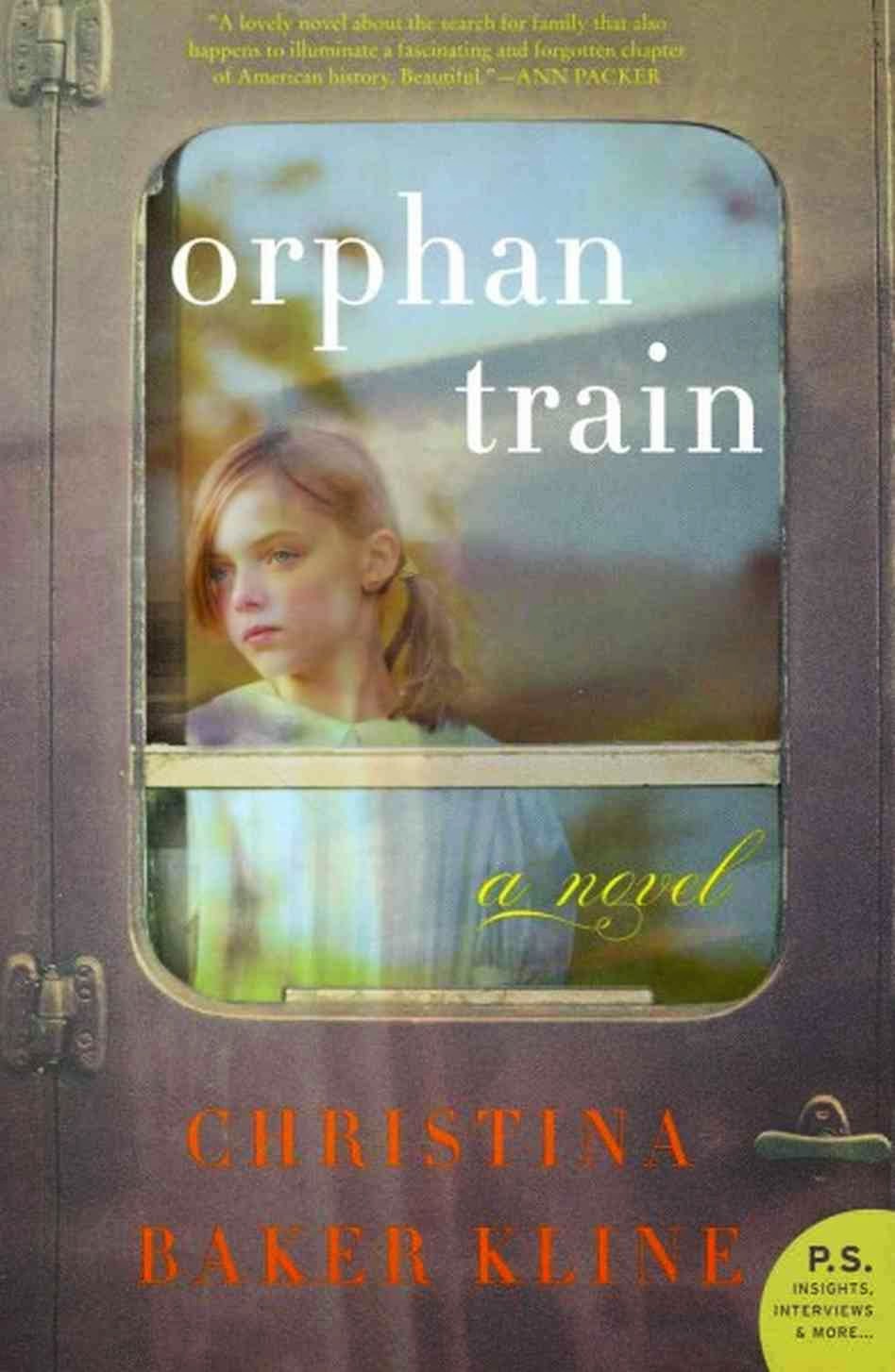
Orphan Train - Christina Baker Kline


These days, I seem to be picking novels that have two parallel stories going that build to tell a more complete tale and explore common themes. Christina Baker Kline's novel is one more of that ilk. In it, her modern day protagonist, Molly completes a school oral history project in which she must ask an interviewee questions about their lives and change. What did you choose to take with you? What did you leave behind? What insights did you gain? Deep questions, all.

Molly is a teenager that will be aging out the foster care system at the end of her high school experience. She has been shuttled about from one foster family to the next over the years. She travels light. She guards her emotions and puts on a Goth facade that isolates her from those around her at school. She tries to never get too close to anyone, as she never knows when she'll be pulled from one family and school to be plunked down in another.

Vivian Daly is an elderly retiree, living in her vacation home in nearby Bar Harbor, Maine. Before retiring, she lead a life as a successful department store owner in Minnesota and has decided that her attic must be cleaned out, but can't manage the heavy work it takes to jockey boxes and cartons, filled with nearly a century of life's artifacts and detritus.

Molly, gets in trouble with the local library when she attempts to steal a book. In order to avoid legal hassles with the foster care system, she signs on to do community service hours and gets hooked up with Vivian Daly. She will volunteer to help Mrs. Daly clean out her attic and thus begins a wonderful friendship. Both characters are guarded about being too open with each other, but as time goes by and the community service hours mount up, Molly and Vivian find common bonds that will help each of them ponder the losses they've had in life, the important things and values that they have carried with them over time, and the need for true emotional connection with others.

I was talking with a friend about this book. She was saying that the local middle school teachers were looking at this book as a read for their students. We both thought it more appropriate for high school. The reading level is not difficult, but the content and topic seemed a bit advanced for young kids. This book deals with immigration and the prejudices that were common during the early 1900's towards immigrants, family losses, abuse, alcoholism, mental illness, rape, the orphan trains that ran from eastern urban centers to midwest towns that brokered 'homes' for young street children and orphans, modern day foster care and the problems with oversight, building emotional relationships and mending those that are 'broken' emotionally. Deep topics, all. I honestly thought discussion of the topics would be more fruitful with older kids. The issues of authority and system failure when abuse and rape are involved would be valuable discussions for teens to explore these days, given what we're seeing in the press.  The issues of immigration and how we deal with the poor and needy could also be valuable discussions with older kids, but could be too 'gritty' for middle school aged kids (IMHO). The historical topic of the orphan trains is pretty complex too and worthy of further research to find out the true stories of thousands of children who were shuttled out of the cities in a Progressive Era social experiment that, while well-meaning, was poorly monitored in many cases. So ... this novel has a lot of 'meat' for a simple story.

The themes don't bog down the story, but they're there. Kline moves her novel along really well, jumping between modern day Maine and Depression-era Minnesota. The reader learns of the tough start to Vivian Daly's life as she is shifted from one foster family to the next during her early teen years. Molly, in finding out certain details of Vivian's life sees the perfect interviewee for her history project and in the process must confront those questions in her own life. All ends well in this book, but one is left to wonder about those thousands of kids and their real life stories ...

A fast and thought-provoking read ...


Tuesday, September 2, 2014

The Fault In Our Stars


From the moment I began reading this novel, I knew why it became so wildly popular with teen readers. John Green has a wonderful way with inner dialogue. He uses it so well in developing the character of Hazel Grace, the book's protagonist. She is sassy and sarcastic, intelligent and full of emotion - wise beyond her years. At the same time, she has all the typical characteristics of a typical teen, right down to her TV watching habits, her dress, her sometimes 'attitude' toward her parents, and her classic teen attitude toward bureaucracy and authority.  Her observations on life and the vagaries of living with a life-threatening cancer diagnosis are at turns funny and wrenching. She bursts off the page of the book and right into the heart of the reader. I mean, really, who wouldn't feel for a young, smart teenager who is waiting for the shoe of Death to drop, but still manages to yank her O2 tank around and build a romance that will last the ages from an encounter at a cancer support group? Pop in some funny and supportive friends and relations, a 'make-a-wish' trip to Amsterdam, and a turn-about ending that yanks out your heart and squishes it flat on the driveway and I'd say you've got an equation for a teen literary phenomenon.

That being said, this book that John Green has written deals with some age-old issues that everyone will grapple with before their time on Earth is done. Wondering if we will ever be truly and deeply loved, whether we will be remembered when we're gone, and just what meaning our life has had will creep into all our brains at some point. Hazel and her friend Gus are forced to deal with these questions sooner than normal. Having teen characters face them with such honesty and angst is what makes this book so powerful. Of course, when a loved one is lost, there is no happy ending, but when deep life issues are confronted and dealt with effectively, there is a satisfaction that comes with the ending of one's life and the moving on that comes afterward by one's loved ones.

There is an equally popular movie adaptation to the book that I will see at some point, but I find it hard to think that it will equal the book. There were so many well-written passages that were thought-provoking and 'quotable', passages that a reader will find sticking in the back of the mind; for me, it was the following  quote. I have pondered it at different points since reading the book - when I contemplate God, when I see some knock-down beautiful view out there in the world, when I felt the unborn kittens in my cat's belly squirm, when I watched friends marry over the weekend and saw that look pass between them while they danced. Yes, the universe demands to be noticed in so many ways.

“I believe the universe wants to be noticed. I think the universe is improbably biased toward the consciousness, that it rewards intelligence in part because the universe enjoys its elegance being observed. And who am I, living in the middle of history, to tell the universe that it-or my observation of it-is temporary?” 
                                                                                                                               - John Green

Good book. Not surprised that it has stuck so long on the best-seller lists. 


Tuesday, October 8, 2013

Divergent - Veronica Roth


Veronica Roth's novel of a dystopian society living in the vicinity of Chicago will inevitably be compared to The Hunger Games. How can it not be compared? Strong female protagonist thrown into a coming of age situation meets strong male protagonist.  Strange chemistry forms a close bond. Danger, murder and mayhem ensue , a bit of romance ignites things, teens take control of their destiny and fight the political elite, teens discover things about themselves and their society that transforms them. It's all there, plus the ending that so obviously leaves the reader with the knowledge that there's 'more to follow'.

This may sound cynical or snooty, but I don't mean it to be that way - just stating the facts cut and dried. This book is one more in the extremely popular sub genre called dystopian novels. The story moves along and the story line is set up in such a way that it makes it rife with conversation topics that can help reading groups, literature classes, or families sort out and debate big issues and emotions. The problem that I have with the book is there is no subtlety. Everything is right out there in your face, as you read. Relationships form quickly, the big questions are right there for all to see and not tease out, events unfold quickly, Tris (the young protagonist) is the voice of the plot and her telling is rushed and almost cold, despite her moments of high emotion. I'm unsure if this is a function of Roth's need to have her main character move the story along at any cost because there's so much more to tell (in later books) or if she developed the character this way to reflect the character's personality trait that makes her seem a classic Dauntless faction member.

That statement leads me to address one of the elements of Roth's story that intrigues me - her choice of factions within her dystopian society. There are distinct groups in her society that serve very specific functions in keeping this culture functioning - Abnegation, Dauntless, Erudite, Candor, Amity, and the factionless. Each group with a capital letter serve specific needs within society. They are caretakers or defenders or providers or truth-tellers and judges or technology geeks and builders. The factionless are the people that don't fit any one group. How does one fit into any one group? That's one of the big questions the reader grapples with in this novel. That question, alone, would keep a group discussing the social theory of conformity and self-determination and free will, and the merits of non-conformity, personality development, the psychology of social development, maturity and personality change, etc. for an age ... which is why this book series is destined to be on many a middle and high school reading list for a while ... or at least until the next big thing gets published that grabs young readers' imaginations.

That last statement leads me to a question I asked myself - I wonder what got dropped from the reading lists of middle and high school literature teachers when Divergent made the list - do classes still read A Separate Peace or Bridge to Terabithia or To Kill a Mockingbird or Great Expectations ? Hmmm ... they're all still big sellers, they all deal with 'coming of age' issues, they all target big social issues, but I wonder who is reading them and how old the average reader is when picking up the book?

I will probably pick up the next books in Veronica Roth's series to see where she takes this society that she's created. I'm curious to see if she can wrap things up for the characters while satisfying my curiosity about the bigger world around this society.  Chicago is a pretty small blip on the Earth's surface ... what's happening elsewhere while our divergent personalities are breaking loose and establishing a lifestyle of their own during dangerous times in their little culture? What are the next big questions? How does a burgeoning Divergent group govern itself? Is there a back story that will come out?


Monday, June 17, 2013

Miss Peregrine's Home For Peculiar Children


Once Upon a Time there was a magical island with a strange mysterious portal to the past ...


Miss Peregrine's Home For Peculiar Children got a lot of press back when it was first published in 2011. A new spine-tingling young adult read, it relies on an old equation - misunderstood young man with unusual ability is drawn to an isolated haven for children with equally unusual abilities that is looked over by a matronly and well-meaning mother figure. Yes, the Harry Potter syndrome strikes again. Once again, age-old themes work with a new author's imagination to give us a whiz-bang adventure fantasy that promises to be ripe for subsequent novels.

Monday, May 13, 2013

Revolution - Jennifer Donnelly


The parallel tragedies of human loss and the spirit's defiance come together in this story of a modern teen's struggle to overcome the tragic loss of her younger brother and her family's disintegration after the boy's death. This modern tragedy is set against the backdrop of a trip to Paris, arranged by her desperate, yet distracted and work-harried father. What happens in Paris becomes a transforming experience for young Andi Alpers - a parental 'putting down of the foot' forces her to attend to a required Senior Thesis that she is required to do prior to graduating from her posh Brooklyn prep school. The thesis, her passion for music, a chance meeting near the Eiffel Tower, her music-loaded iPod, and her immersion in the events of  The Reign of Terror carry her off on a journey of discovery - an inner revolution that changes a forlorn depressed teenager into a more self-aware survivor.

This is a terrific book that is well researched and doesn't dumb down its content or edgy take on modern teen culture for its young adult readers. I have to respect that. It nudges itself a bit more space against the more frivolous teen reads on the library shelf. I can only hope that Donnelly continues to give her young readers more meaty books like this.

Couldn't help making connections to Neil Gaimen's Neverwhere when reading the passages about Andi's tour and adventures in the catacombs ... creepy and reminiscent of Dante's Inferno too.


Tuesday, March 12, 2013

The Bartimaeus Trilogy - Jonathan Stroud


Audio books have been one of the greatest additions to classroom and public library stacks - in the years that I spent in the classroom, more than a few audio books were instrumental in lighting a reading fire under some of the most reluctant readers (nine times out of ten, young boys) that came my way. Consequently, I have a soft spot in my heart for any audio book that holds my attention, has a fast plot, an excellent narrator/reader, and is unabridged.

This series, that I stumbled upon in our little public library, caught my attention from the first words uttered by Simon Jones. Mr. Jones is an established Broadway actor with the deepest and most sonorous voice - his verbal abilities and vocal characterizations of the numerous characters in Jonathan Stroud's trilogy make for a wild romp for any young adult reader/listener who has a hankering for a good fantasy tale.

The trilogy centers on the relationship struck up by a young magician-in-training named Nathaniel. Nathaniel summons a jinni named Bartimaeus early on in Book 1 of the series and their love/hate relationship forms the basis for an involved tale of political intrigue within the British government, strained relations and rebellion between the common people and the magician hierarchy that rules the United Kingdom, and the mystery of the void in which jinni, imps, fairies, monsters, and demons reside in the ether of the universe. It's a fantastic and fun story that is full of magic, wild escapes, and mad adventures.

Suitable for kids eight and above, there is the occasional 'naughty' word - nothing horrific, but vernacular, just the same, a touch of innocent romance, the usual rough 'potty' humor that tickles the pre-pubescent, and a lot of sarcasm and wit. Some parents may think it coarse, but I say it's an innocent and fun crowd-pleaser.

Mr. Stroud writes like a screenplay writer in that his scenes are short vignettes that are descriptive and easily envisioned - an important skill when writing for young readers. His command of dialogue is good, although I think reading the dialogue for a struggling reader would be too much, as some of the wit and sarcasm might be lost on one working to carry the thread of the sentence structure and length of dialogue passages. He has been clever in structuring the series around three characters, a young girl named Kitty, one of the common folk who is in rebellion against the magician leadership, as well as Nathaniel and Bartimaeus. Girls as well as boys will enjoy the series and have a character to identify with. Mr. Stroud also does a good job of developing his characters over the course of the series ... one is not disappointed with the way things end, although it may not be to the liking of all readers.

A worthy audio book series ... enough said!


Wednesday, January 23, 2013

Boys Without Names - Kashmiri Sheth


The upper level of the building is cramped with bodies and trays of beads, frames, a smelly glue pot, the rolled up tatters of jute bedding and sundry little personal items. Six young boys work feverishly placing small beads onto blunt needles and then sticking them into position on wooden frames. They work quietly, so as not to raise the ire of their Boss, who sits in an easy chair in the room below. The television rumbles sometimes or the Boss can be heard snoring as he naps the day away. The doors are all locked; there are bars on the windows. From the outside the building resembles a ramshackle warehouse. Inside, though it is a prison of work and deprivation.

Thus, is the story of Gopal and his cohorts. How Gopal comes to this bleak sweatshop in an alley in Mumbai and how his cohorts cope with such a brutal life is the story that Kashmiri Sheth tells. It is, at times, heart-breaking and at others, hopeful. It brings the reader in contact with good people and people who are broken and brutal. Gopal is a resourceful and strong protagonist who never loses hope that he will be reunited with his family, who uses his wits and savvy to survive under circumstances that would make many of us despair.

The issue of child labor and sweatshop evils has come more and more into the public eye, over the past few years, as the commercial consumption remains high and the supply of cheap, but well-made goods streams into the country from third world nations. American consumers, being so far removed from the source of products, can easily buy everything from jewelry to hangbags to picture frames to clothing to fireworks to coffee and never connect their consumption patterns with the practice of slave labor ... slave labor. That's what it is ... in bold black and white. Within our own country, there are wide-spread abuses of  workers within the agricultural fields, as everything from tomatoes to oranges to celery is brought to market. A practice that this nation turned its back on so many years ago continues to this day and we consumers unwittingly (or blythely) ignore its continuance in the blind need to consume without investigating the source of our 'stuff'.

Kashmiri Sheth has put faces and names to the nameless workers who labor every day in sweatshops, in writing this powerful novel. While hers is a book written for a young adult audience, there are plenty more out there to read and think about. There are agencies to investigate and support that work toward economic equality, fair labor practices, humane treatment within the work place, and education of workers. I know I will never look at an inexpensive picture frame again without wondering whose young fingers might have created it.

Kashmiri Sheth traveled to India to research her novel and I am very glad that she did. I can only hope that more people read this book and discuss the important topic of economic justice with their friends and families. I would recommend this book as a family read-aloud, a class or church youth group book club read, or as a scout troop read and investigation project. It is a vivid story that has all the brutal components of the issue without such graphic horrors that it would traumatize kids. It would be a real eye-opener for those ten years and older. An important book ...


Tuesday, January 8, 2013

Jepp, Who Defied the Stars - Katherine Marsh


Take a look at the cover art on this book. Whom would you suppose this book is written for ? I had  this conversation with my nephew and he agreed with me that this book cover would appeal to upper elementary and perhaps middle school students. That being said, as I got into the story of Jepp, a young Belgian boy of the late 16th century, I became convinced that not only is this a story for older students and adults, but it has content that is ripe for discussion with older teen-agers. Issues raised in this book range from a person's right to know their parentage and familial history to issues of gender equity, the rise of scientific inquiry in the early Christian world, sensitivity to the issues that people with physical disabilities have, rape and a person's personal responsibility to victims of sexual and emotional violence, and the will that everyone has to make their lives mesh with their dreams and hopes. It goes on and on ... all very deep and weighty topics.

All these issues are wrapped up in a well-researched story of the rise of the astronomical research done by such early scientists as Tycho Brache and Copernicus, the courts of the Spanish nobility, and the fate of a young court dwarf named Jepp whose misadventures take him from Belgium to the coast of the North Sea and to points beyond.

Katherine Marsh has written an excellent story that lets the reader be drawn into the fictitious life of the young protagonist, Jepp as well as the gritty world of court politics. It takes all Jepp's intelligence and fortitude to survive and prosper in this world where the divide between nobility and commoner is so stark, where God-given rights are easily trampled by nobles in their rush to live their lives of plenty and reach higher on the social ladder, where court hangers-on will do much to establish a safe spot of ease for themselves at the expense of the rights and comforts of the less fortunate, where a young man must be determined in order to overcome the odds and take control of his destiny.

This has been a good read all the way around ... but my one recommendation to Ms. Marsh and her  book's publishers would be to change up the presentation on the book jacket ... fast .... before this book gets relegated to the elementary school library book stacks.


Monday, April 30, 2012

Reckless - A Novel by Cornelia Funke


"The sheet of paper slipped out of a book on airplane propulsion. Jacob only picked it up because he thought he recognized his father's handwriting on it, though he quickly realized his error. Symbols and equations, a sketch of a peacock, a sun, two moons. None of it made sense. Except one sentence he spotted on the reverse side: THE MIRROR WILL OPEN ONLY FOR HE WHO CANNOT SEE HIMSELF. Jacob turned around - and his glance was met by his own reflection."

                                                                        - Cornelia Funke in Reckless

Would you dare walk through the mirror and enter a mysterious world, foreign to all your experience and knowledge? Well, would you ?